Mobility-Based Vehicle Match
Choose an ambulatory, wheelchair, stretcher, or bariatric vehicle from the patient's actual ability to walk, transfer, and sit upright safely.
Phoenix Non Emergency Medical Transport matches each dialysis patient with an ambulatory, wheelchair, stretcher, or bariatric ride based on transfer ability and whether the patient can sit upright safely. The right vehicle, securement, attendant support, and pickup timing matter because treatment can leave a patient fatigued, lightheaded, cramping, or hypotensive.
Choose an ambulatory, wheelchair, stretcher, or bariatric vehicle from the patient's actual ability to walk, transfer, and sit upright safely.
Before moving the patient, check for fatigue, dizziness, cramping, or a blood pressure drop, then load slowly with the right level of assistance.
Plan the return pickup around the treatment end time plus the 15-30 minutes many patients need to become steady enough to travel.
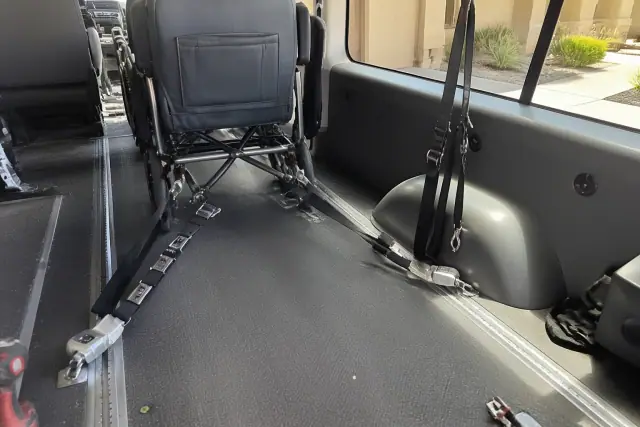
Four-point tie-downs stabilize a wheelchair inside a lift-equipped van before the vehicle moves. This scene helps readers recognize the securement points that matter during transport.
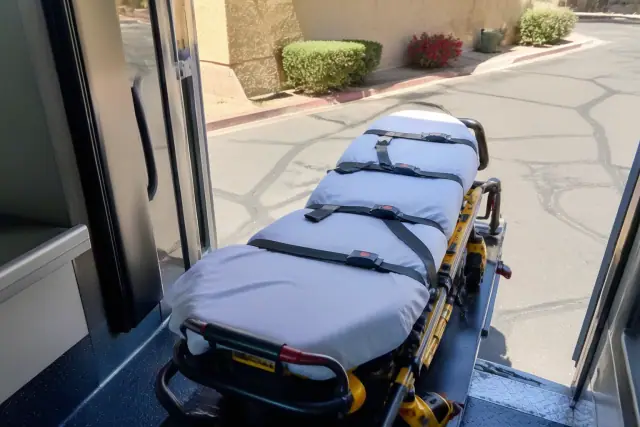
Horizontal positioning, straps, head support, and attendant access distinguish stretcher transport from a seated wheelchair ride. This setup is intended for a patient who cannot sit upright safely.
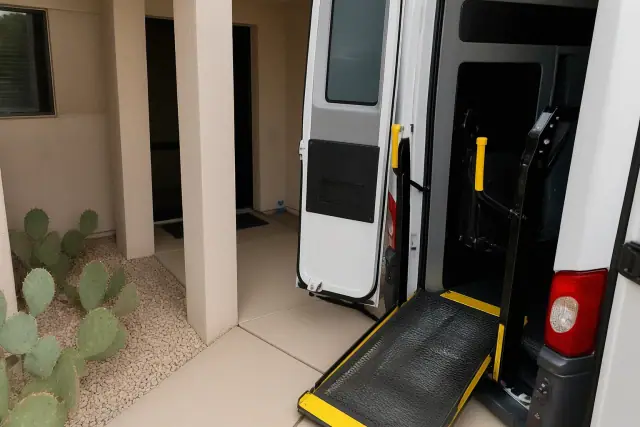
Door-to-door assistance continues from the clinic entrance to the vehicle instead of beginning and ending at the curb. A walker or personal belongings can change the time and help required.
Tell the dispatcher whether the patient walks, uses a standard or heavy-duty wheelchair, can transfer, and can remain seated safely.
Reserve recurring rides 24-72 hours before treatment so the appropriate vehicle and pickup window can be assigned; same-day requests depend on availability.
Build a 15-30 minute post-treatment buffer into the return pickup when the patient needs time to become steady enough to move.
NEMT is designed for stable, scheduled rides rather than urgent medical situations. Dialysis transportation is estimated to cost $3.0 billion nationally each year, with about half spent on ambulance transport, so ambulance use should follow medical necessity.
| Patient mobility | Transport method | Key setup |
|---|---|---|
| Walks and transfers independently | Accessible sedan or van | Standard seating with minimal transfer help |
| Remains in a wheelchair | Lift-equipped wheelchair van | Hydraulic or ramp lift and four-point securement |
| Cannot sit upright safely | Stretcher van | Horizontal positioning, straps, head support, and an attendant |
| Needs higher-capacity equipment | Bariatric-equipped vehicle | Reinforced ramp, wider entry, and higher-capacity lift |
The safest method follows the patient's actual transfer ability on the day of the ride. A patient who walks and transfers can use an accessible sedan or van; a seated wheelchair user needs a lift and proper securement; someone who cannot sit upright needs a stretcher; and a patient requiring higher-capacity equipment needs a bariatric-equipped vehicle. Intake should also confirm door-to-door help and equipment such as a walker or oxygen tank before dispatch.
Post-treatment fatigue, low blood pressure, cramping, or lightheadedness can require a slower transfer and recovery time; attendants should also avoid pressure or a blood pressure cuff on the vascular access arm. Phoenix summer heat, often exceeding 110°F, makes working air conditioning and hydration planning within the patient's fluid limits especially important. Trip distance changes local private-pay pricing: for 1-5 miles, ranges are $30-$50 ambulatory, $50-$70 wheelchair, and $100-$150 stretcher; for 5-10 miles, $40-$60, $60-$80, and $120-$170; for 10-20 miles, $50-$80, $70-$100, and $150-$200, respectively.
Stable dialysis patients can travel by car when they can transfer safely and the trip fits the treatment schedule, but post-session fatigue, dizziness, or blood pressure drops may make driving home unsafe. Air travelers should arrange dialysis at the destination weeks ahead, transfer treatment records, confirm insurance and treatment protocol, and verify carry-on rules before leaving Phoenix Sky Harbor International Airport. Original Medicare generally covers transport only when medically necessary, usually by ambulance, while some Medicare Advantage plans may include NEMT; eligible AHCCCS members may receive non-emergency rides. Patients seeking free or subsidized transportation can ask their clinic social worker about AHCCCS, nonprofit grants, or dialysis-center shuttle programs because eligibility varies.
Share the patient's mobility, transfer ability, equipment, clinic time, and likely recovery needs. A transport coordinator can use those details to identify the appropriate vehicle, assistance level, and pickup window.